
What December Actually Does to the Water Off Palm Beach
Two things are true about Aruba in December and visitors usually only arrive knowing one of them.
The first is the one people hope for. The Meteorological Department of Aruba puts the island’s average December wind at 6.6 meters per second, roughly 15 miles an hour, against 8.8 in June — the figures come from its 1991 to 2020 climate normals. December also sits below the 7.4 annual average, inside the quiet run that starts in September and ends when the trades pick up again in the new year. On the leeward side, where Palm Beach and Noord are, that difference is small on paper and obvious in the water.
The second is the one nobody mentions. The same table puts December rainfall at 80.1 millimeters out of an annual 451.1 — close to a fifth of the island’s yearly rain inside one month, spread across about eleven days. Aruba is a dry island and December is the wet end of it.
What lighter wind does to the leeward side
Aruba’s coast is split by the trade winds. The windward side faces open ocean and stays rough most of the year; the leeward side is sheltered year round, and taking the wind down from 8.8 to 6.6 turns already protected water into something genuinely placid.
For snorkeling that shows up as visibility. Less surface chop means less sediment stirred up and less glare breaking the surface, so a reef like Boca Catalina reads clearly from above instead of through a moving ceiling. On the Antilla wreck, where the structure runs deep and wide, a flat surface is the difference between seeing the outline of the ship and seeing the detail on it.
Boat comfort moves in the same direction, and it moves further than the raw numbers suggest, because a passenger feels the motion of a hull and not the speed of the air pushing it. A catamaran crossing a 15-mile-an-hour breeze sits level in a way the same boat does not in a 20-mile-an-hour one, and that single difference decides whether a nervous passenger enjoys the trip or endures it. Parasailing gets a steadier, slower lift and a gentler landing back on the deck. That landing is the part first-timers are actually anxious about.
Planning around December rain instead of hoping it away
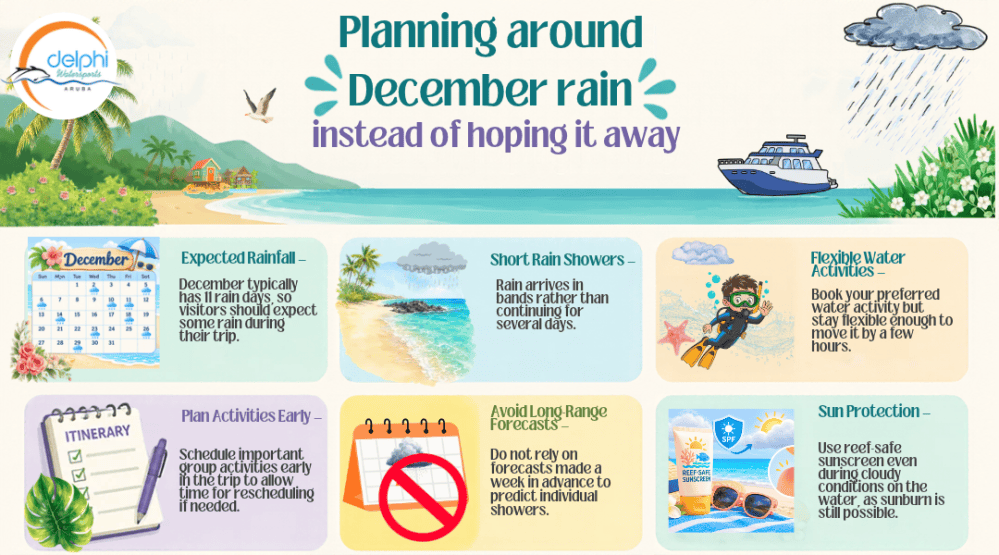
Eleven rain days in a 31-day month is not a washout and it is not nothing either. The practical reading is that you should expect to see rain during a December week here, that it arrives in bands instead of settling in for days, and that the island does not shut down for it.
What that means for a trip is simple. Book the water day you want, keep the flexibility to move it by a few hours, and do not try to outguess a shower from a forecast a week out. If your group has one activity everyone agreed on, put it early in the trip so there is room to move it if you need to.
Sun protection deserves a mention for the opposite reason. A cloudy stretch on the water still burns, and December visitors arriving from a northern winter have the least prepared skin of anyone we see all year. Reef-safe sunscreen, applied before you leave the room so it has time to bind, covers most of it.
Who gets the most out of flatter water
Beginners, children and anyone who has had a rough boat ride and never forgotten it. Those are the passengers for whom the gap between 15 miles an hour and 20 is not a detail — it is the whole experience. A first-time snorkeler who can stay relaxed at the surface sees far more than one who is fighting it, and a child who has a good first trip will get back in the water tomorrow.
Jet skis are the exception, and it is worth saying plainly. A waverunner is fun in chop and fun on glass, and a rider chasing a bit of adrenaline sometimes prefers the rougher spring water. Calmer conditions are not a downgrade there; they simply give you a longer, faster run before you need to slow down.
The warm part is the part that does not change
Air temperature on Aruba barely moves across the year. The December daily high averages 30.7 degrees Celsius, about 87 Fahrenheit, against 33.2 in September when the island is at its warmest, so the wind that does blow is pleasant rather than cold and the sea stays comfortable for swimming.
That stability is why the island fills up through the northern winter, and it is also the catch. Conditions being better is exactly why more visitors want to be on the water in December, and the boats leaving from the Palm Beach strip carry a fixed number of people. The sailing you most want is the one that goes first.
Pick Your Day and We Will Sort the Rest
Delphi Watersports operates on Palm Beach in Noord, Aruba, on J.E. Irausquin Blvd, and every trip and rental is listed at delphiwatersports.com.