
October Is the Quiet, Better-Value Month for Aruba Watersports

The beach in front of the Hyatt Regency in February is a different place than the beach in October. Same water, same reef, a third of the people. If you can travel now, this is the month we’d tell you to take.
October in Aruba is a shoulder month — showers pass through and move on — and the island sits well south of where Atlantic storms usually track. We’ve been running boats and watersports off Palm Beach since 1992, and this is the stretch of the calendar when we can be flexible with you — earlier slots, longer private charters, less queueing for anything. Here’s how we’d plan a water day around it.
Quick Summary: Key Takeaways
- It is the off-season, and that is the point: the same water and the same reef, without February’s crowds or February’s prices.
- Aruba sits at about 12 degrees north: far enough south to be outside the corridor most Atlantic hurricanes travel.
- The season’s statistical peak is behind you: NOAA puts it at September 10, with activity tapering through October.
- Wind decides the order of your day: we shuffle the schedule around it rather than fighting it.
- Private charters are easier to get now: the same boat costs the same and the calendar is emptier.
October Sits Between the Showers and the Rush
Aruba’s busiest months run December through April, when the northern hemisphere wants sun. The Aruba Tourism Authority calls September through November the off-season. That gap is the whole appeal. The water is warm. The beach still has space on it at eleven in the morning. Rain arrives in short bursts that clear as fast as they came, which is a fair trade for having the place to yourself.
For a family that means less waiting. For a couple it means a sunset boat that doesn’t feel like a shared bus, and a crew with time to talk to you rather than turning the deck around for the next group. We’d rather have you here now than in the third week of December. We’ll say so on the phone.
The Island’s Position Does Most of the Work
Aruba lies at roughly 12 degrees north, along the southern edge of the Caribbean and well below the belt that most Atlantic systems travel through. Geography, not luck. It’s why boats keep running here while the official storm season is still on the calendar.
The numbers are worth knowing rather than worrying about. NOAA’s National Hurricane Center climatology puts the Atlantic season at June 1 to November 30, with a statistical peak on September 10 and an average of 14 named storms and 7 hurricanes across the 1991 to 2020 period. By mid-October that curve is falling.
The Wind Decides the Shape of Your Day
Aruba is a windy island. Always has been. That breeze is what keeps it comfortable in the sun, and it is what makes the leeward side of the island — the Palm Beach side, where we operate — the calm place to be on the water.
So we read the day rather than the forecast for the week. Flat morning water suits a kayak or a stand-up paddleboard along the shore. A breezier afternoon is better spent behind a boat on a tube or a waverunner, where chop is part of the fun. If you tell us what you want out of the day, we’ll put the pieces in the right order.
This Is the Month to Take the Boat Privately
Private charters make more sense now than at any other point in the year. The calendar is open, so we can put you on the water at the hour you actually want rather than the hour that’s left.
Our 45-foot catamaran, Dolphin, has been running off this beach since 2005, and a private sunset charter on her is the thing guests remember from the trip. Groups celebrating something book the whole boat. Two people on an anniversary do the same thing and just enjoy the space.
How We’d Build a Half Day on the Water
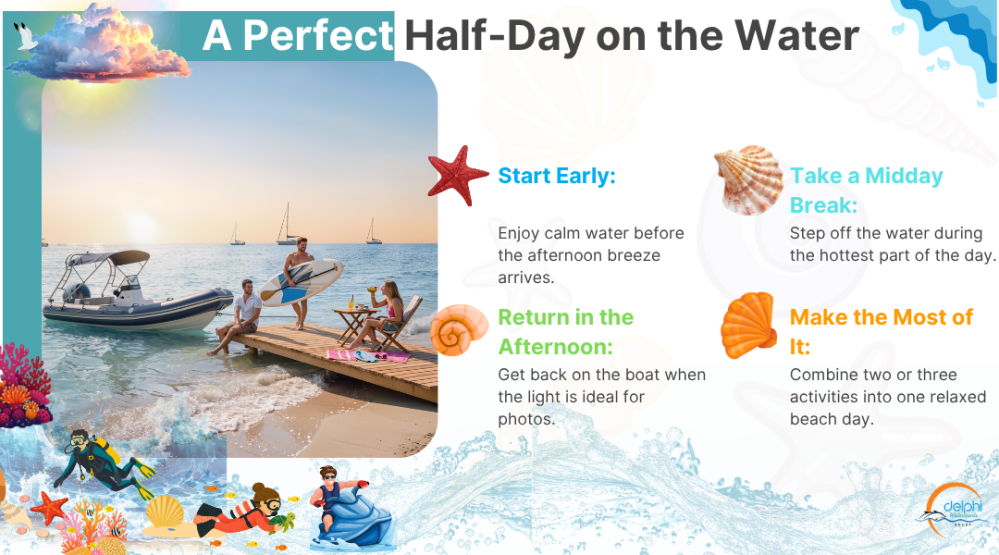
Start early. Get the flat-water activity done before the breeze fills in, take the middle of the day off the water, then come back for the boat in the late afternoon when the light is worth photographing.
That shape — calm morning, break, golden evening — is how we’d spend our own day off, and it’s why the combination bookings exist. One trip to the beach, two or three things done, and nobody standing in the sun waiting for a slot.
Frequently Asked Questions
Q: Is October a good time to visit Aruba?
A: It’s one of the better months for value. Aruba’s rainy stretch runs from September into January, and November is the wettest of it, but the showers here tend to pass over in minutes rather than settle in for a day. The beaches are far quieter than from December onward. Rates and availability are both easier too.
Q: Does Aruba get hurricanes?
A: Very rarely. The island sits at about 12 degrees north, along the southern edge of the Caribbean and below the corridor most Atlantic systems follow. NOAA’s season runs June 1 to November 30, with the statistical peak on September 10.
Q: Is the water calm enough for kayaking and paddleboarding in October?
A: Usually in the mornings, yes. Palm Beach is on the leeward side of the island, and the wind typically builds through the day, so we put flat-water activities early and boat activities later.
Q: Do I need to book watersports in advance in October?
A: It’s easier than in high winter, but we’d still book the boat charters ahead. Waverunners, tubes and beach rentals are usually available on the day at this time of year.
Plan the Water Half of Your Trip With Us
Tell us who’s coming and what they’d actually enjoy — someone nervous about the water, a teenager who wants speed, a couple who want quiet. We’ll build the day around that rather than selling you a list.
Delphi Watersports, on the beach at J.E. Irausquin Blvd in front of the Hyatt Regency Hotel, Palm Beach, Noord, Aruba. Open daily, 9:00 AM to 5:00 PM. More at delphiwatersports.com.